Project Summary
Countries: Ecuador, Ghana, Vietnam
Delivery Partner: University of Oxford
Project Partners: Tay Nguyen University (TNU), Kwame Nkrumah University of Science and Technology (KNUST), Universidad Regional Amazonica (IKIAM), PanNature, WWF Ecuador
Principal Investigator: Dr William Thompson, Knowledge Exchange and Research Fellow, Nature-based Solutions Initiative, University of Oxford.
Contact: william.thompson@biology.ox.ac.uk
The Flourishing Landscapes Programme (FLP) advances landscape-scale socio-ecological research in coffee and cocoa forest-frontier landscapes to understand how biodiversity strengthens ecological resilience and livelihoods.
Challenge
Tropical forest-frontier landscapes are faced with intersecting pressures from biodiversity loss, climate change and declining smallholder resilience. Coffee and cocoa production are expanding into biodiversity hotspots while being highly vulnerable to climate variability and market instability.
Although agroforestry and other nature-based solutions are promoted across these landscapes to address these challenges, empirical evidence on how biodiversity within these systems contributes to climate resilience and nature’s contributions to people (NCPs) at scale remains limited. Additionally, farmers often lack accessible tools to translate ecological knowledge into adaptive management strategies, and value chains rarely provide financial incentives for measurable biodiversity and ecological gains.
Insight
Through interdisciplinary teams, FLP combines ecological research, human-centred design approaches and financial innovation across biodiversity hotspots in Ecuador, Ghana and Viet Nam.
- We conduct landscape- and farm-scale socio-ecological research in coffee and cocoa agroforestry systems to quantify how biodiversity influences microclimate regulation, pest suppression, soil health, and broader NCPs that underpin climate resilience and farmers’ livelihoods.
- Through participatory co-design processes with rural communities and farmers, we develop farmer-led decision-support tools that translate ecological data into adaptive management strategies. These tools strengthen farmers’ capacity to manage risk while enhancing biodiversity and long-term productivity.
- Finally, we work with value chain actors to explore biodiversity-informed risk-sharing and risk-transfer mechanisms in cocoa and coffee value chains. Through modelling and stakeholder co-design processes, we explore how financial instruments can contribute to nature-positive production systems.
The challenge is therefore to generate robust evidence, empower farmers to apply it through co-designed tools, and identify financial mechanisms that can align biodiversity conservation with climate adaptation and supply chain investment.
Collaboration
FLP builds on a consortium of research institutions and civil society organisations working across three biodiversity hotspots. The Nature-based Solutions Initiative at the University of Oxford leads the project in close collaboration with Tay Nguyen University and PanNature in Viet Nam, Kwame Nkrumah University of Science and Technology in Ghana, and IKIAM and WWF Ecuador in Ecuador.
These partnerships combine academic and practitioner expertise and knowledge, ensuring that research design and implementation are context-specific and locally relevant. The consortium builds on longstanding collaborations and cumulative long-standing experience across tropical agricultural landscapes.
Dr William Thompson
Dr William Thompson is a Knowledge Exchange and Research Fellow at the Nature-based Solutions Initiative, University of Oxford, where he leads the Flourishing Landscapes Programme and the High Agricultural Reforestation Potential (HARP) Toolkit. His work integrates socio-ecological research in tropical coffee and cocoa landscapes.
Previously, he worked with Sainsbury’s and the United Nations World Food Programme, coordinating the implementation of a weather risk transfer mechanism for smallholder farmers in Tanzania. He completed his doctorate at ETH Zurich on food systems resilience in global value chains.
Photo Credits
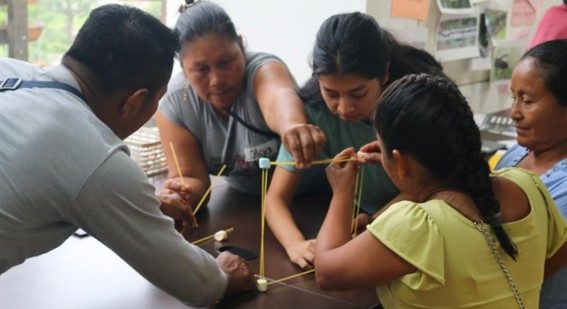
Photo 1: In the photograph, cocoa producers are seen working collaboratively to build a tower using spaghetti and marshmallows, trying to keep it from collapsing. This type of exercise has been implemented in various settings as part of the co-design methodology, which aims to foster creativity and participation.
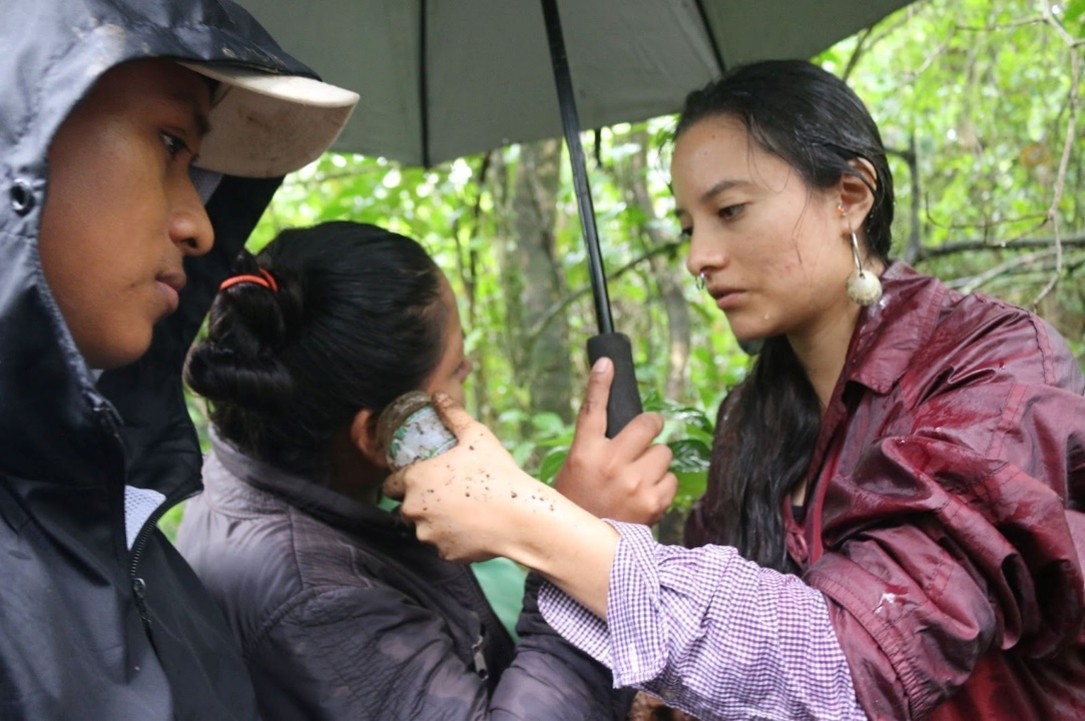
Photo 2: When science and the earth speak: an Agroecology student and a farmer explore how the soil breathes. Together, they listen to the sound of hydrogen peroxide reacting—revealing the hidden vitality of organic matter.
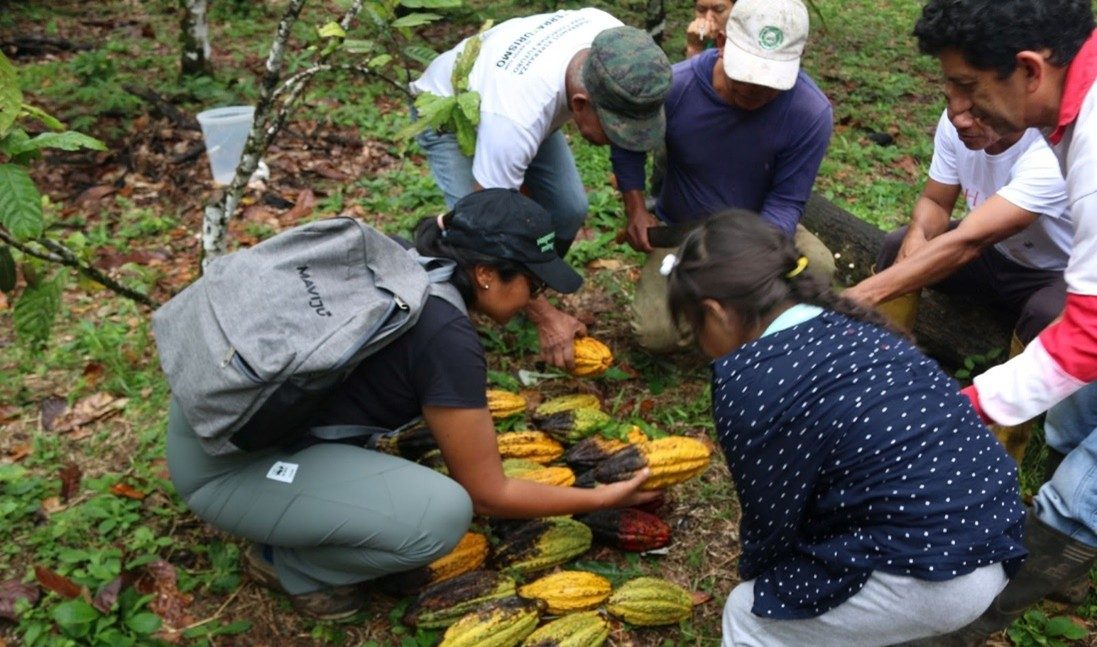
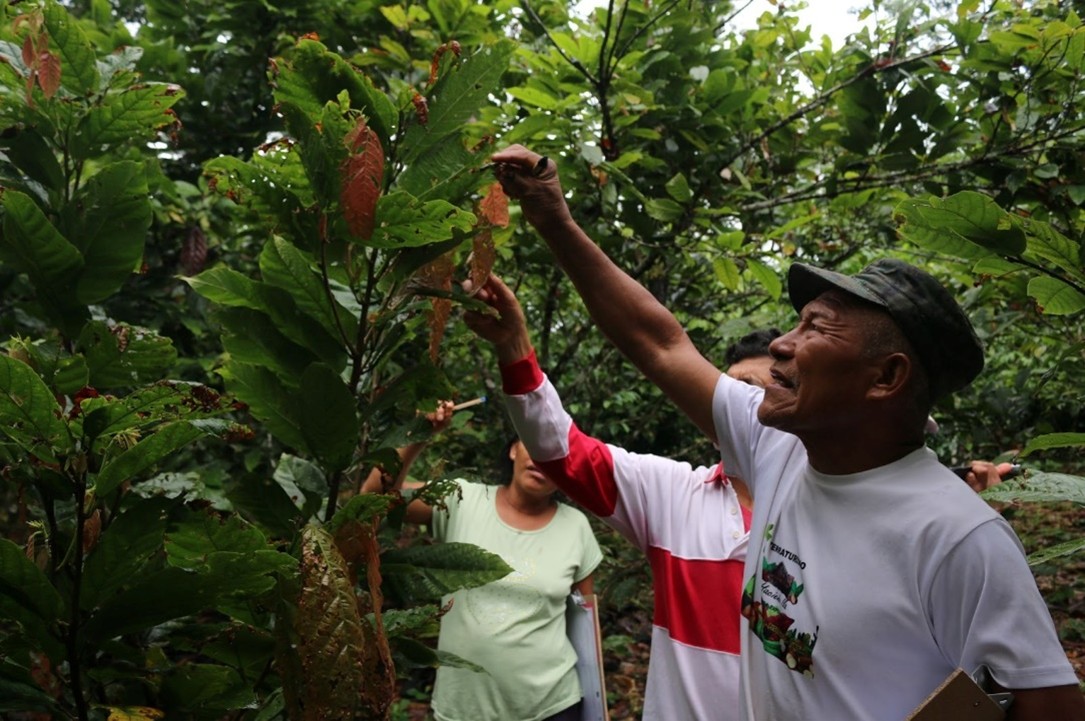
Photo 3: Cocoa brings us together: community and knowledge unite to identify affected cacao pods. Each observation is a step toward healthier and more sustainable crops.
Photo 4: Wisdom that grows from the land: farmers identify pests through experience born of the soil. Their knowledge is living science, nurtured by dialogue and daily practice.